Political Manipulation
Political Manipulation - How Visuals Influence Your Perspective - A Review of the VP Debate and Subconscious Manipulations by CBS
Oct 3
Written By Paul McDermott
Visual Manipulation is Common
As a photographer who has shot countless campaign photos and supported small businesses in conveying stories that they want their audience to believe, I consider myself a master visual manipulator.
Every story and advertisement we experience is a manipulation - it’s a visual narrative attempting to influence viewers to align with a certain viewpoint about a product, person, or thing. I’ve spent thousands of hours studying and researching visual aspects of body language, color theory, perspective, lens selection, lighting, framing, and how to combine the various elements of an image or video to influence how something is perceived.
These tools are nothing new and they are used among all storytellers (including each and every film you’ll ever see). What you will hear from the greatest storytellers is that when their job is done right “their footprint becomes invisible.” This means that the manipulation is so subtle that the viewer is unconscious of it and simply aligns with the emotion / mood / feelings that a storyteller intends. Great storytelling uses your subconscious to lead you into their story.
Unconscious Manipulation in News
We live in a world where the news has become a biased source of information. The American people openly discuss right or left news sources and look towards news sources that align with their way of thinking and share the stories in a way that they like to identify with. What happens when a news source is responsible for neutrality and still influences bias via visual manipulation?
This isn’t meant to be a political piece but an observation on perspective. In watching both the Presidential and Vice Presidential debates, I recognized some visual tools that may influence the way people feel about a candidate. The statements here are for awareness. These tools can also support you in how you choose to represent yourself visually.
Innate Perspective in our DNA
I’m going to do a brief overview of some of the psychology on perspective and the things we will be looking at in the proceeding photographs I took of my TV during the Vice Presidential Debate.
Despite being evolved, sentient beings we are still animals in nature. Much subconscious bias comes from this and there are simple reasons why. When we are born we begin our lives looking up to bigger, taller humans. These bigger humans are the authority. They teach us, nourish us, and take care of us because they are stronger, wiser, more capable, experienced, and more dominant. They teach us right and wrong, show us love, and know more / better than we do. As we mature, we take on these attributes for ourselves but subconsciously we have spent our entire lives being indoctrinated into believing that someone bigger is the authority and holds more power.
This is not without merit - as an animal it is generally understood that a creature larger than you can cause you greater damage and, likewise, you can cause greater damage to creatures smaller than you. Size up to a grizzly and determine who is more likely to win the fight. Size up to a cricket and determine the same. Within a species it is likely that a bigger and stronger male will be able to dominate over smaller males and claim his position as the alpha male and primary breeder in a community. Generally, the larger a mammal the more authority they have within their community.
Big, tall men have historically been attributed to more success in business. They are more easily regarded as an authority in their subject area and, subconsciously, we see them as more capable to lead. As an animal, these genes are preferred. Even women gravitate towards tall and strong men as part of the innate viewpoint that he would be a more capable partner to protect and provide for the family.
This is all built into our animal DNA as part of our survival instincts. While it is true that we have evolved and these viewpoints may not be the truth we live with today, it is important to understand that these general beliefs are what have kept us safe and supported our thriving as a species on this planet. By becoming aware of these unconscious beliefs we can choose to observe them and make a more deliberate decision.
Perspective Bias in Visual Representations
When working for a client I refuse to slander or compare them to their competition. I chose to highlight the best of what they want to share. This creates integrity and alignment with their story rather than a blatant comparison. I leave the comparison to the viewer. Below are some representations from the debate that blatantly use perspective for manipulation. I will describe some of the subconscious elements that are in play here.
Pre-Debate Icons
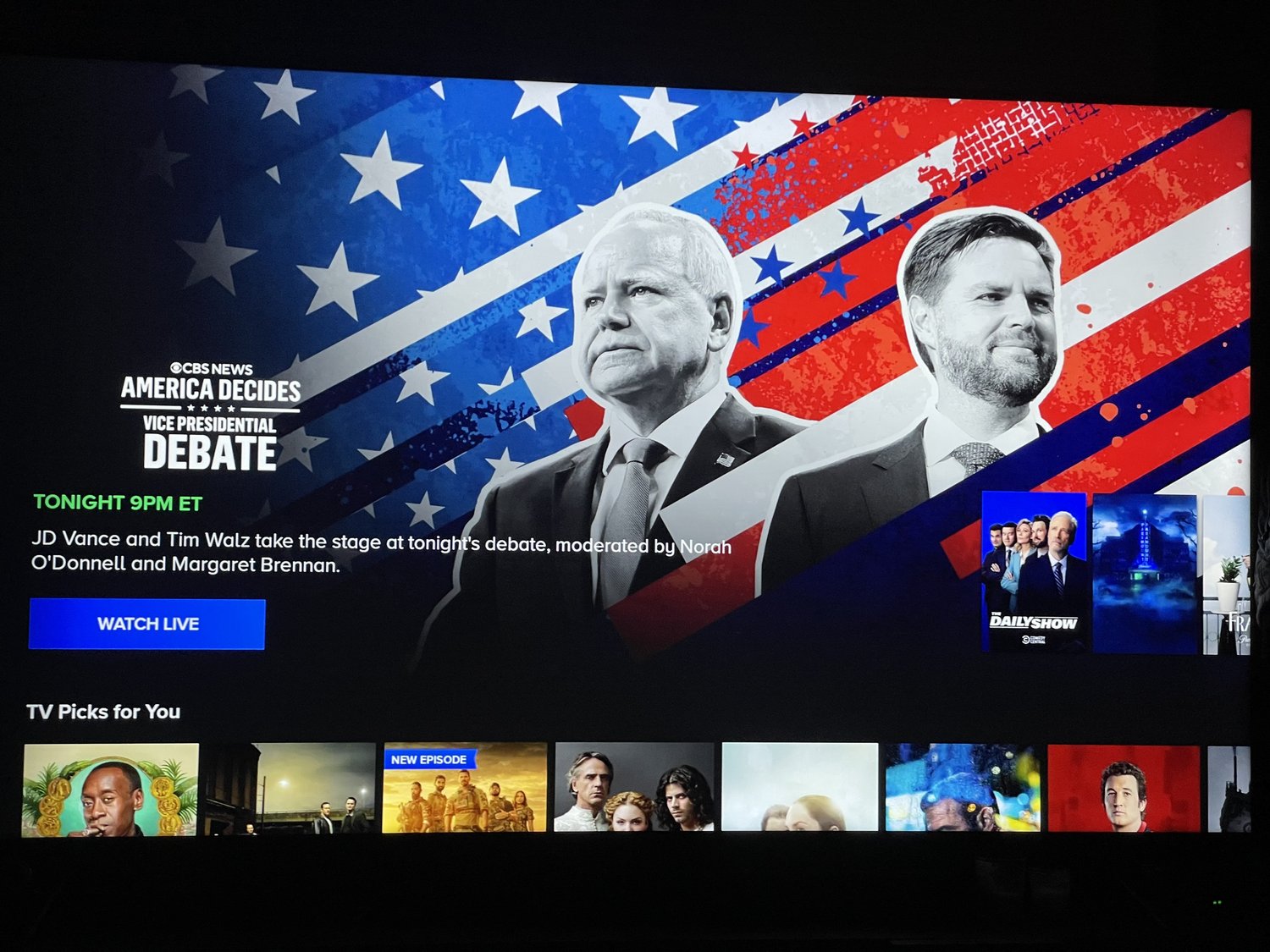
CBS / Paramount App Opening Screen for the Event
The main screen implies preference for one candidate.
Western cultures read left to right. By reading into Walz, you experience him as more open / trustworthy. Vance, with his back to you (note the abrupt shoulder but not revealing his chest), is depicted as less approachable. Vance is looking into a wall that abruptly ends while Walz is staring into a fade that implies infinite space - a visionary.
Walz is the center screen, literally taking the center of attention. The negative space on the left leads into him with leading lines from the background looking up to Walz and directing your attention towards him as the subject. Lines lead away from Vance. Republican colors only represent 1/3 of the frame with rigid linear lines behind Vance. Walz is decorated with stars. (We want a star as VP, right!)
The chest is one of the vulnerable parts of a body and revealing the chest creates vulnerability. (Once again in our DNA.) By openly being vulnerable to others you are presenting yourself as trustworthy and less threatening. By completely covering up Vane’s chest (especially when Walz is exposed) it implies that there is something to hide in comparison.
Lighting on a Subject
I am adding this point here because it is more obvious in black and white images. Note the light direction on each of the subjects. The light is coming into Walz’s face. You see a reflection in his eye. It contours his jaw line and is a flattering image, depicting him as strong and masculine. Vance has light coming across his body and, on his face, the light is dark around his eyes. When you can’t see someone's eyes or they are hiding their eyes, what does that lead you to believe about them?

Smaller Thumbnail with Color Images
Secondary Thumbnail Image
Here you can see both candidates looking to the middle. These are the same images in color and used differently. This image is focusing attention on the event branding. Both men are looking towards AMERICA DECIDES.
You’ll notice Walz is darker here than depicted above in the b/w image. Our eye is drawn to the lightest part of an image. Here, in the color version, that would be Vance. Also you’ll notice that in color the smirk expression is more friendly. Even the coloring, slightly yellow, warm as we call it in photography (like warm sunlight) tends to have a more friendly look. Warm = welcoming.
The color version ages Walz - with the reflection on his head more evident due to the contrast in color from his skin tone. Above was a deliberate choice to make the image monochromatic and conceal some of these elements.
Height Bias
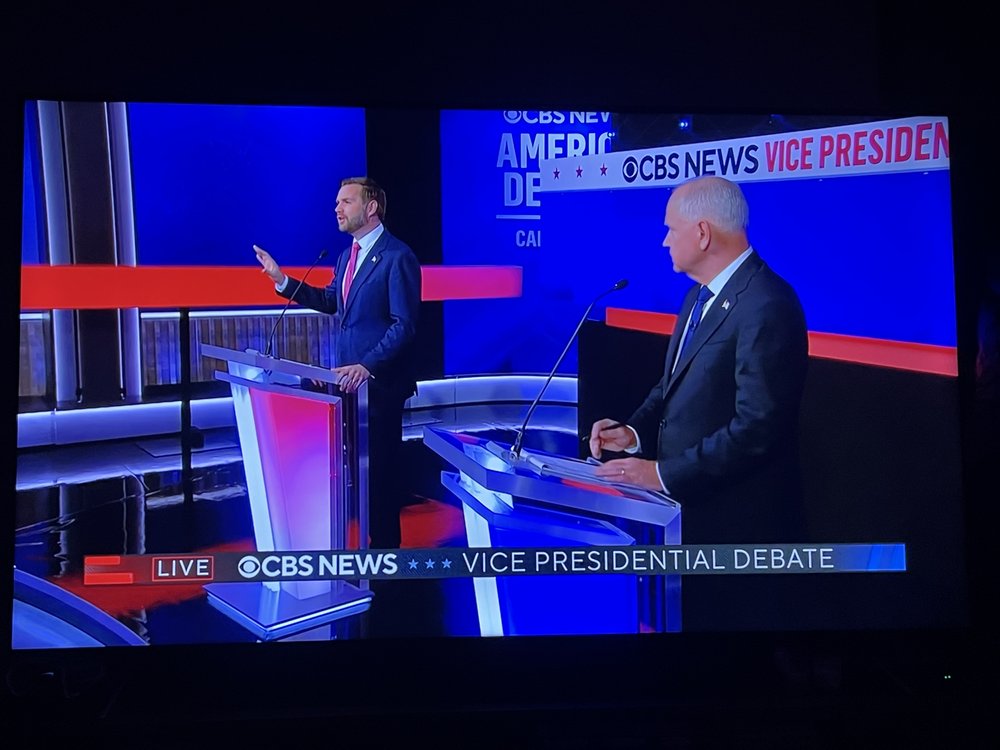

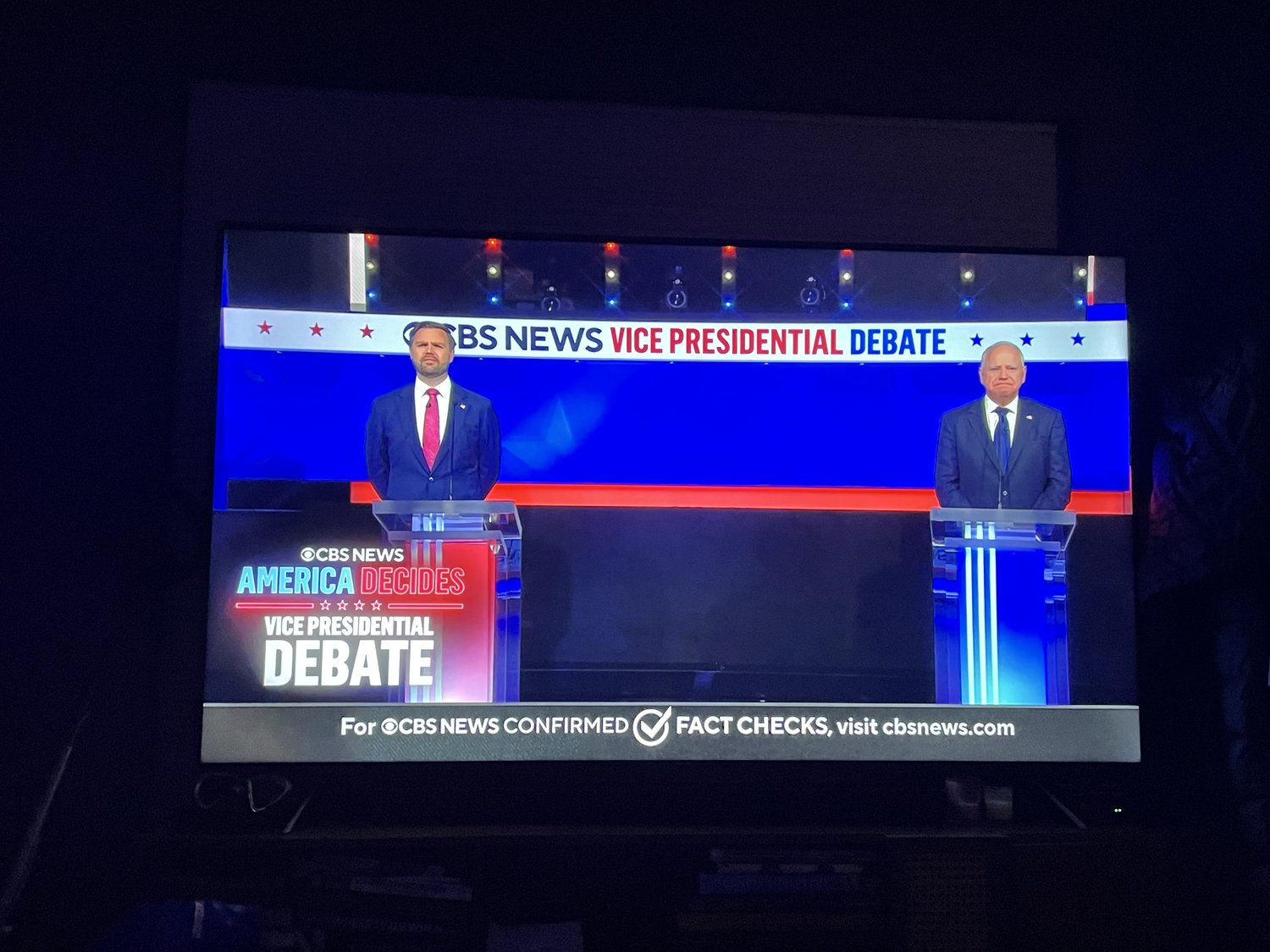
One of the very few straight on shots during the debate. Vance is noticeably taller.
Manipulating Height / Dominance
As mentioned above there is a certain dominance, authority, and power associated with height. As you see in the straight on image, Vance clearly has a height advantage over Walz. Great care has been taken in this debate, as well as the Presidential debate between Trump and Harris, to avoid angles that depict the height difference. Harris was even provided a platform at her podium to minimize height discrepancy. Candidates were mostly shown individually with a split screen to avoid this subconscious bias towards height. Unfortunately, that was taken to another level to create subconscious bias.

Clear difference in perspective to make Walz look bigger / more dominant over Vance

Note the scale, mic position, and shoulder height.
Two cameras NOT created Equal
There are many different aspects to these shots that, while you’d say they are the same, they are actually very different.
1) Crop - Vance tended to fill the frame more during the debate. Walz was, at most times, smaller in the frame than Vance. Vance looked more authoritative because of this.
2) Shoulder Height - Despite Walz being smaller in the frame he was placed higher in the frame. His shoulders, at most times, were above Vance’s. This depicted him as being over, or more dominant, than Vance.
3) Camera Angle - Notice the microphone placement on the candidates and the separation between the mic and their chin. Vance’s mic implies that he was shot from a slightly higher angle, looking slightly down on him (implies weaker, lower, less than). Walz’s relationship to his mic implies that he was shot from a lower angle (implies power, authority, bigger). If Vance didn’t have a beard we would be able to identify this more easily by observing his neck line compared to Walz. (Shooting upward you will see more neck.)
Closing - Decide for Yourself
The point of this entire post isn’t to sway anyone politically or push any agenda. I purely want to reveal where there are subconscious beliefs we have and how easily they can be manipulated if we don’t pay attention. My desire is that with this knowledge individuals will be able to identify when they are being manipulated through a visual perspective and choose to decide consciously, and not unconsciously, what you decide to believe - especially when it comes to politics.